
The ACCS (Association of Classical Christian Schools) annual conference has almost become a family tradition. This year, none of the siblings made it, so we brought Skip instead!
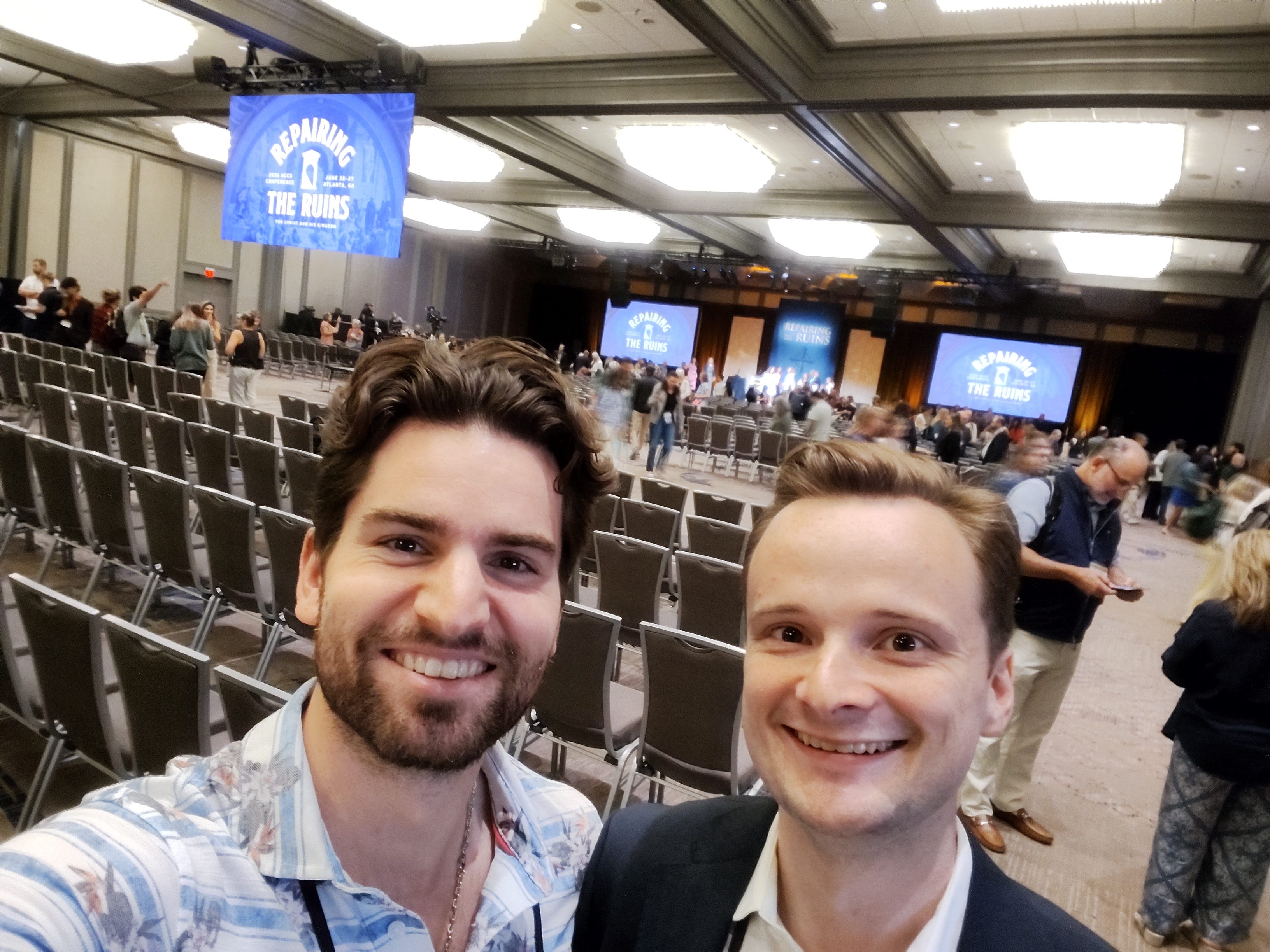
Educators from all over the world convened in Atlanta’s Renaissance Waverly for three days of drinking from an intellectual firehose. Besides the buffet of plenaries, workshops, and panel discussion, the conference provides an opportunity for fellowship among Christians who are invested in the advancement of God’s kingdom through education. I found former headmasters and coworkers, made some new friends, and even engaged in some late-night card game shenanigans while someone played bagpipes in the lobby (no kidding). The ACCS national choir blessed us with a performance of Vivaldi on Thursday evening, before singing hymns in the hotel lobby.
I broke the habit of a lifetime and took notes this year, even though Josh Gibbs told me not to. Here is a distillation of some high points.
ICCA
“Shout on, pray on, we’re gaining ground!” says the old hymn. A contingent of educators from Brazil attended the conference this year, and I have met representatives from Hungary and Africa in past years. The ACCS now has an international network, the International Classical Christian Alliance (ICCA). Praise God for the expansion of Classical Christian Ed outside the United States!
America 250
Christopher Perrin presented the Adams family (no, not THAT Adams family) as a history of American education. John and John Quincy received a classical education which prepared them to lead the young American nation. Charles Francis Adams, however, considered his classical education impractical and inadequate for actual life.
Henry Adams stood between two worlds: the heir of classical education, he witnessed the industrial revolution change the topographical, social, and educational landscape of America. Henry held more in common with John and John Quincy in his appreciation for classical education. At the same time, he recognized the conditions behind Charles Francis’ dismissal of the same education.
Perrin asserted that Henry Adams used his classical education to critique modernity, particularly in his comparison of the Virgin and the Dynamo. Henry Adams recognized that in the past, Christianity brought coherence to the world. And yet, in his time, Christianity found itself displaced by technology, which brings a coherence of its own.
In the Adams family, we observe different responses to classical education which convey different visions for America. John and John Quincy value classical education as preparation for citizenship and leadership. Francis Charles dismisses classical education as impractical. Yet Henry’s critique suggests that classical education preserved something which pragmatism cannot replace: the coherent worldview of Christianity.
The last century of American education fleshed out the chaos of “practical” concerns and veneration of the dynamo (technology). Education which aims at practicality, and which brings in every new technological contraption, presents a world constantly in flux (even Heraclitus would be dizzy). Classical, Christian education works well because it is not beholden to practicality, or to keeping up with trends. It focuses the student on the permanent things, which allows the student to interpret the times rather than being swept along by them.
America is in some kind of revival, which is encouraging to see. Nevertheless, we could go back to political, social, and religious decay just as quickly as we seem to be waking up. It is faithful Christian communities which have the opportunity to stand firm in a world full of change. The revival of classical Christian education bodes well for America. But even if America falls, the work we do for the Kingdom is eternal.
Technology
Henry Adams presented the Virgin and the Dynamo as conflicting worldviews: one held together by religion, the other by technology. A number of the presentations implicitly or explicitly addressed problems that technology brings. If I were a luddite (it’s tempting), I would say that modern technology across the board ought to be destroyed (technologia delenda est!). A more realistic assessment is that we continue to progress without accounting for the effects of technologies.
Dr. David Diener of Hillsdale described technological change as ecological, like removing or adding a species from a habitat. It is not a simple addition or subtraction: the entire environment changes, in various and unexpected ways. Likewise, technologies change us in more ways than we expect, or than we can notice.
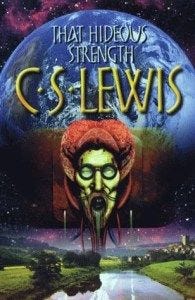
A panel discussion on Artificial Intelligence probed the connection between LLMs and logos. LLMs imitate the reasoning power which, in classical tradition, distinguishes humans from animals. Is ChatGPT a bastardization of the trivium? Perhaps. I am still making up my mind, but chatbots remind me of the disembodied head in That Hideous Strength.
The presentations on tech were well-researched, thoughtful, and balanced. This bodes well for the ACCS. We’re asking the right questions and developing more formulated answers. The challenge, as well as the opportunity, will be putting theory into practice.
Athens and Jerusalem
Overall, the ACCS is more Jerusalem than Athens. This is really the only way to preserve Athens with any integrity. In practice, the learning of Jerusalem is an intellectual heritage and a doxological heritage. One of the strengths of the ACCS is its culture of worship. Christian worldview and study of Scripture proliferate the classroom, but the schools are marked by corporate reading, prayer, and singing. These cultural markers arguably play a greater part in forming the students and faculty than what occurs in the classroom.
The conference follows suit: Scripture and Christian worldview are apparent in the presentations, but the attendees also sing and pray together, and there is the obligatory Doug Wilson devotional to begin the conference. In the ACCS, there is a clear sentiment that worship is the foundation and end of education.
Church and State… and Academy
An interesting development in the last year is the new partnership between ACCS and Turning Point Education. (Jacob and I attended their conference last year.) Rumors of conflict within TPUSA make this partnership something to keep an eye on, although not necessarily a reason for concern. It does openly associate ACCS with a certain political vision, although anyone who knows the ACCS’ CREC ties shouldn’t be surprised (we have Pete Hegseth, after all). ACCS is pretty adamant about placing Christ and his church at the center of cultural renewal, and letting politics flow from theology.
Same Time Next Year?
The three days in Atlanta went by quickly, and there was much to recommend. The topics of technology and the Athens/Jerusalem question have been on my mind as I return to the “real world” from grad school, and many presentations furthered my own thoughts (which will appear on OPA soon).
Friendships were renewed, purpose rekindled, vision recast. See you there next year in the beautiful city of Louisville, KY!
"The challenge, as well as the opportunity, will be putting theory into practice." That particular statement is a KEY foundational reminder that seemingly echoes what the Lord Jesus Christ has told us: "Why do you call me 'Lord, Lord' and not do what I say? As for everyone who comes to me and hears my words and puts them into practice, I will show you what they are like. They are like a man building a house, who dug down deep and laid the foundation on rock. When a flood came, the torrent struck that house but could not shake it, because it was well built. But the one who hears my words and does not put them into practice is like a man who built a house on the ground without a foundation. The moment the torrent struck that house, it collapsed and its destruction was complete." (Matthew 7, Luke 6)