Three Observations about Episcopal Leadership in America
A Delicate Letter to Friends

Dear friends, I’m putting this out for your benefit, and at a few of y’all’s request. I am not a spokesman of the ACNA, I do not know either party personally, and I am not making any assumptions about the guilt or innocence of Archbishop Wood. Before my words are read, please read David Roseberry’s. If you feel like you're spiraling, read Dean President Hollon’s remarks on discipline in the church. My reflections were sharpened by theirs (though they’re not responsible for mine).
For regular Our Present Age programming, check out Sam Sadler’s essay on sailboats from yesterday morning.
Strongman Leadership in Anglicanism
Canon Roseberry’s Substack summarizes the challenges of the accusations made against Archbishop Wood well. Many of the actions that can be concretely proven to have taken place are very...normal. Discretionary funds, car funds---these are normal parts of being a Rector.
Strong charismatic leadership is almost a necessity in Anglican ecclesiology. Whoever said Anglicanism doesn’t encourage strong personalities doesn’t know Anglicanism. It runs on big personalities. It has for centuries. They’re usually the best preachers, or the most dynamic organizers. Sometimes they’re also narcissists and control freaks. Or worse.
Bishop William Meade, “through whose preaching the church of Virginia rose as from the dead” got his by start unilaterally blocking the invitation for the next bishop, shouting down the elderly committee until he got them to relent. If memory serves, he then sent discouraging letters to the potential candidate telling him all the reasons he was unqualified. Meade was 24. John Wesley would spontaneously announce a hymn-sing whenever somebody proposed an amendment at his assemblies that he found distasteful. “The world is my parish,” he wrote. That was Wesley at his best and worst.
A secret of Anglican ministry is that you have to be a little bit controlling to run and grow a church or diocese in the ACNA. This is because you, as rector, are ultimately responsible for every shortcoming, and honestly, many of the successes. There’s no committee, presbytery, or congregation who can take the fall for you in our ecclesiology. Bylaws and committees don’t fit so well in episcopacy as they do in the Presbyterian world. They can’t given the oaths and vows clergy take.
Wood was one of the best in terms of mixing strong authority, convincing preaching, and church growth, and he was the best by being highly controlling and a visionary. When he lost the race for bishop of South Carolina, he left the diocese and started the Diocese of the Carolinas. That was a gutsy move, and it paid off. He was clearly right about the trajectory of TEC.
That sort of my-way or highway leadership burns a lot of people out, and I don’t blame those exhausted. It’s a tough way of doing ministry, and it is not for everyone. This rough edge is very common with those coming out of TEC. It was the way to survive.
Those who stayed got it worse. I’ve been told that the canon and onetime Dean-President of Trinity Episcopal School for Ministry (now Trinity Anglican Seminary), Paul Zahl, at the end of his career, after decades of fights over his gospel preaching, climbed the pulpit and started yelling at his Bethesda congregation something like “You’ve won! You’ve won! I will never preach to you on the bondage of the will ever again!” Ephraim Radner’s recent Mortal Goods is a staggering tribute to suffering in ministry, but it’s hard to not read it as reaping the whirlwind of standing by TEC come hell or high water.
Taking a beating just is the path of Anglican Holy Orders. Of course, dealing with trauma through high school QB style leadership is, as Roseberry says, fundamentally different from taking romantic or sexual advantage of employees. There’s no room in St. Paul’s qualifications for that. Full stop.
Again, if Wood did that, he needs to step down. If that’s not what happened, he should sit through the trial and have it play out. Maybe the courts will find that he went canonically too far in other cases, even if he didn’t do anything sexual, that will be disciplined according to the canonical standard the bishops, clergy and laity agreed upon.
The Courts of the Church:
Here’s a funny trick about ecclesiastical law. Church courts don’t work on innocent until proven guilty, they’re based on preponderance of evidence. This is traditional, and the way most episcopal forms of government work around the world. If there’s a 49% chance somebody is a pedophile, for instance, that’s just too high a risk for somebody to put back in charge of a flock. Episcopal courts are a sapiential form of justice where prayer, context, knowledge of the ministers, hard evidence, likely motivations are all things to consider. There are hard boundaries, but there’s nothing like mandatory minimum sentencing or free and open access to evidence.
But here’s the problem: no American knows how to deal with this form of innocence/guilt standard. So while ACNA is returning to a historic standard that the Church of England and many Anglican Churches around the world have used, my understanding is that the Episcopal Church (USA) significantly modified this form of government to correspond to the federal and state government standards of the late 18th and early 19th century. In otherwards, 2000s American Episcopal church courts were corrupt forms of American legal courts, they weren’t a training ground for ACNA to learn how to use historic canon law.
So how do Americans litigate at this late stage in our republic? Largely through public opinion. And where did the accusers go to litigate? The Washington Post. This is a bit like bringing a nuke to a knife fight. It’s also how The Episcopal Church taught clergy to fight.
WaPo would force a hearing on the matter and from the get-go create the cloud of illegitimacy that would be the starting position for the prosecution (see? even I am using American civil law categories). The very preponderance of evidence that is supposed to be collected in secret council, after being sorted out to avoid the noise, was broadcasted on the front end. How a court recovers legitimacy and authority from that is hard to say.
Again, a lot of folks who have worked with Wood aren’t happy with his leadership in their own lives, and they may have a sound canonical case. If so, justice be done. But we should note how this trial is being conducted. The litigants, we will see, will say they feared the very forms of ecclesiastical justice so much that they released their complaints to the public to win the case before they brought the presentment.
The Challenge of Episcopacy:
Episcopacy is Church-Monarchy. It’s an open question if it can survive with the same level of media exposure as democratic forms of church government. A certain distance and covering is needed to exalt the office with the authority needed to give a single man legitimacy over 15-40 something churches. It seems to me that the office must be endued with a kind of legitimacy and right of succession that would make a Baptist blush, even if he washes the feet of his presbyters and is a truly godly and kindly man.
The 1969 reality TV special on the British Monarchy was banned by Queen Elizabeth II in part because it revealed too much about the normal lives of those who were being trained to govern the United Kingdom. It created a kind of improper familiarity (the irony is not lost on me that this is one of the charges against Abp. Wood).
American Episcopacy is not nearly so formal as the British Monarchy, but the ACNA bishops have made the conscious decision to move in that direction, legally. If we egalitarian Americans can peaceably live with that kind of official authority is yet to be seen. It might be the best way out of the cult of authenticity, but our near term chances don’t look great.
Action Items:
Pray for ACNA, and use the whole Psalter. Ask for the righteous to receive vindication. Call out for the slanderers to be caught in the trap their hands have made. Pray that brothers would dwell together in unity. Beseech the Lord for perfect judgment. Give thanks for the new disciplinary canons that have been put in place. How God answers each of these prayers, who he reveals as the violent and who as the oppressed, who are the weak, the foolish, and the simple, will be revealed in time.
Please re-read Fr. Mark Brians’ 2022 Archbishop Essay (first prize):
*Parrhesia: “boldness about the truth that hazards death and rejection”
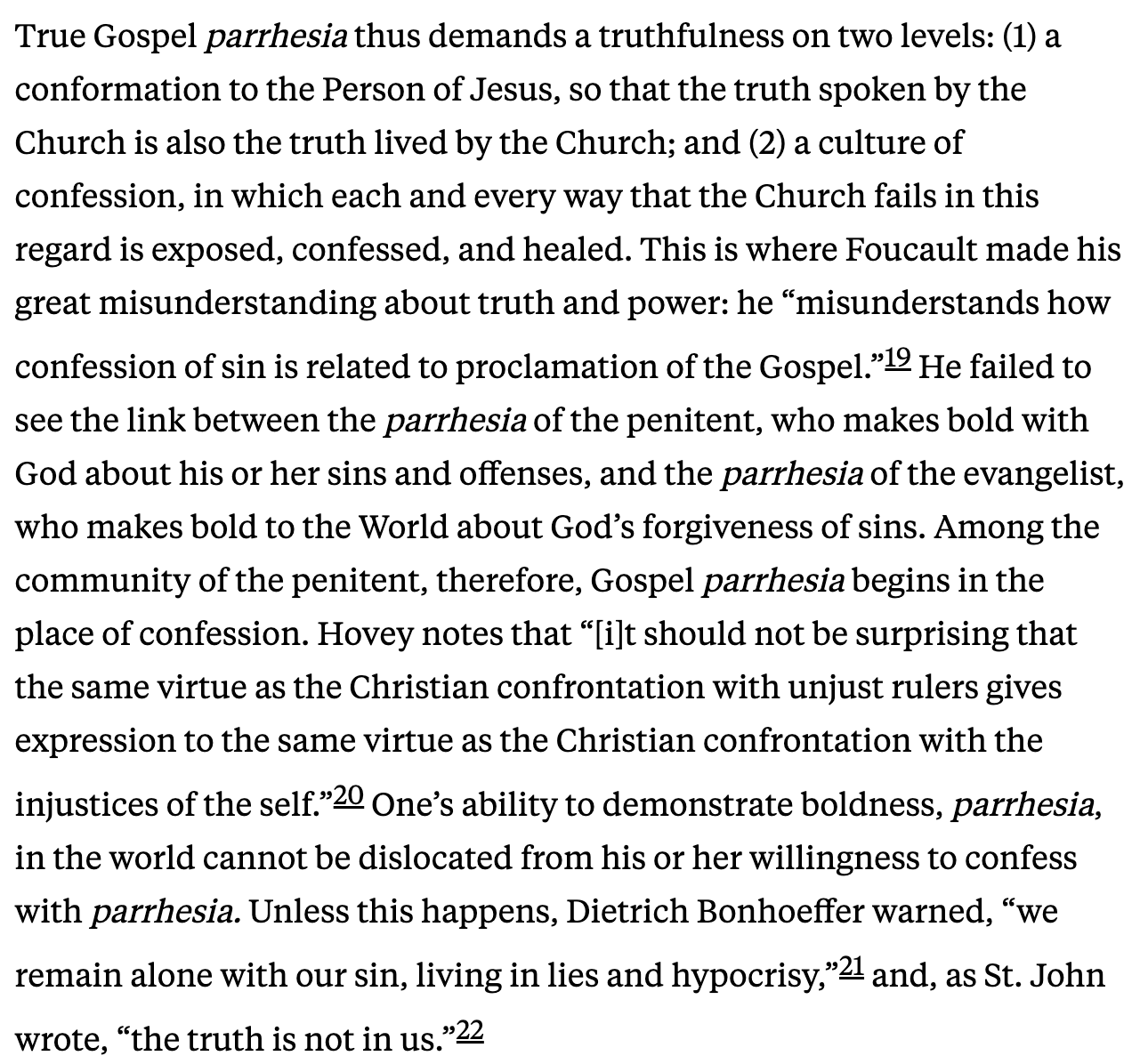
We can proclaim the gospel boldly because we confess our sins daily. Keep your family by your side. Keep short accounts.
Grace and Peace,
Jackson Waters
Actually, this essay was really good!
Good essay, Jack